⊕ E P I S T L E of J A M E S ⊕
James’s address is intended to instruct from the viewpoint of familiarity, as many of the audience for this letter were Jewish. This epistle was written for those converts outside of Palestine. Since the congregation is in its infancy, his speaking is instructional in nature. The voice of the text sometimes chastises, but at other times encourages. The letter’s firm convictions are belief in God, faith in His works, and acceptance of his elder brother, Jesus, as Messiah. James delineates foundational faith notions about practice and the proper pathway.
James’s letter emphasizes love and perseverance. At the time of writing the early church was still forming, and love between good fellows must take precedence. Perseverance is also required as the most practical companion in this formative period. James encourages conversion to his brother, Jesus, as the Jewish Messiah. The exalted teachings of Jesus now come forward: love before condemnation, mercy is to work with justice, from which true justice is then implemented, with a strong emphasis on treating all persons equally. These attributes helped form the early Christian church. Because of his focus on manifesting actions relative to faith, many Christians view James as minimizing faith and improperly accentuating works; however, this assertion is incorrect, as James directs people toward constructive behavior combined with a unified faith practice.
According to Jewish tradition, James (Ya’akov) is the next eldest to Jesus and is mentioned first in Matthew 13.55. James’s position as chief rabbi of the Messianic Jewish Synagogue (Jerusalem) defines his authority and accredits his status as a Torah teacher. He spoke for Nazarene adherents and was known as a Tzaddik, or wise man, even among non-Messianic Jews. The family of Jesus was well-educated in the Torah.

Jeffery Butz writes, “James the Just, as Clement calls him, is the appellation by which Jesus’ brother has most commonly been known in the church’s writings. It is a title originally bestowed upon James by early Christian groups such as the Nazareans, the Ebionites, and the Elkesaites, who revered James for his outstanding righteousness under the law and considered him to be the leader of the apostles after the death of Jesus.”*
*From The Brother of Jesus and the Lost Teachings of Christianity. Inner Traditions, 2005, p.10.

The strongest religious influence in Judea was Pharisaism, whereas Pharisaism was less prevalent in Galilee. In the Hauran (northeast of the Sea of Galilee), Pharisaic influence may have been non-existent. The Nazarenes would be located in the Galilee, north of the Dan River and east into the Hauran. The Essenes occupied these lands after they departed with the Teacher of Righteousness in 150 BC. Remember that Paul took his priestly training in Arabia (Hauron), and then completed his training in Damascus.
James presented the Torah within a traditional context of values, much as we see in this epistle. He speaks to obeying the law and celebrating Jewish holidays, but more so dealing with issues of faith, and emphasizing unity or cohension within the church. He supports attributes such as love, as well as speaking to the issue of individual faith-actions. Now overseen by Jesus’ spiritual interpretation of Torah, James presents Judaism as a corrected interpretation of the law. The new element is Jesus, the Jewish Messiah, and his teaching of the Way. With the ascension of the Messiah’s teaching, the full breadth of the Torah becomes expounded, and James must be considered a central part of the new movement, both in understanding and practice.*
*Others, such as Paul, would cast Judaism away in favor of the messianic teaching only.
As John 7:2-5 indicates, James’ conversion did not occur immediately. It seems clear that even in Galilee (Jn. 7.9), Jesus’ family and others feared the influence of “the Jews” (Jn. 7.13); that is, no one would speak openly on behalf of Jesus for fear of retaliation, such as being kicked out of the synagogue, or worse. It is unknown when James converted to his brother’s ascendancy. However, in I Corinthians 15.7, he most definitely would have, for after appearing to the disciples and the five hundred, scripture states that Jesus appears before James.
Some orthodox criticisms overlook the significance of James. Trusted by Jesus, James would be the most knowledgeable in Torah interpretation and teaching. James will make the final decision concerning Paul’s ministry to the Gentiles and Peter, who is sent out to the Jews. James is the first bishop of the transitional church, not Peter. Later, James will determine what Jewish laws do not have to be followed by Gentiles, thus assisting the structure of the formative church, which is no longer Jewish. James is the pivotal leader of the early church.
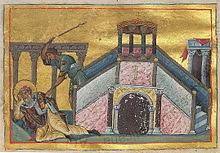
James becomes potent within the Jewish community.
The Sadducees, Pharisees, and an aroused populace martyred James in AD 62.
‡
Perseverance
For those who walk in the Way, perseverance cannot be emphasized enough. Perseverance reflects the core of faith, continuing even when we are uncertain. Faith and perseverance work together. “Testing of your trust produces perseverance” (Jm. 1.3, CJSB); and v. 4, “But let perseverance do its complete work; so that you may be complete and whole, lacking in nothing.”* Trusting in God yields increased perseverance, regardless of setbacks or emotional distress.
The King James reads:
Jm. 1.3, “Knowing this, that the trying of your faith worketh patience.
4 But let patience have her perfect work, that ye may be perfect and entire, wanting nothing.”
*The Complete Jewish Study Bible (recommended for accuracy); note differences, ‘complete and whole’ as opposed to ‘perfect and entire’; also, ‘perseverance’ vs. ‘patience.’
Perseverance is a powerful attribute of character. It can occupy the place of needed knowledge or wisdom until such wisdom or blessing arrives. Perseverance is an establishment of faith and is connected to harvest. No one argues the perseverance of Jesus, for example, nor his faithfulness. As we all know, undertaking a pathway will require perseverance, but regardless of circumstances, James recommends not abandoning your pathway but persevering.
‡
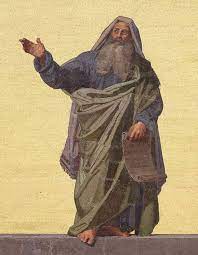
Faith and Desire
Now, if any of you lacks wisdom, let him ask God, who gives to all generously and without reproach;
And it will be given to him (Jm. 1.5).
Trust, and do not doubt, “for the doubter is like a wave in the sea being tossed and driven by the wind” (1.6). Doubt will fill the vacuum of faith should faith leave, and doubt will eventually become a man’s companion. People should undertake their actions with a measure of faith, or else the person becomes “double-minded,* unstable in all his ways” (v.9). To avoid doubt, faith and perseverance are required, and both are a good seed to sow. Perseverance is continuing despite stress or without immediate results, with faith supporting daily spiritual expression and behavior as one walks in the Way. Both persistence and continuity rely upon a faith foundation.
*Faith/Doubt
In 1.14, James refers to perseverance related to temptation: “Each person is tempted whenever he is dragged off and enticed by the bait of his own desire.“* Desire is denoted as bait, and the word of caution, ‘dragged off,’ lies underneath. James defines Desire as ‘bait’; he defines Desire as the person having ownership, that which comes from the individual. Sowing the good seed to end improper desires or excess would be an action James would approve of.
*evil inclination
James clarifies that unrighteous Desire comes from within and remains at hand.
“Sin crouches beside you,” God warns Cain. It is beside us because it is of us, whether viewed as the ‘fallen’ nature,  tainted nature, fleshly nature, or simply bad judgment.
Once the Desire is conceived, birth to sin is given (Jm. 1.15), and “when it is finished” (=completely finished, excess), it “gives birth to death.”
So by continued faith, including faithful actions, unrighteous Desire (sin) becomes removed, and perseverance remains. “Don’t delude yourselves, my dear brother,” James concludes.
‡
Words or Actions?
The attribute of faith relies upon a relationship with God and His kingdom and, further, the witnessing of His Spirit. To witness, or witnessing, does not mean by words only; actions (actual change) speak louder than words. Or, in other words, the witnessing a person is given from within is intended to be made manifest without. Faith without actions can turn brave men sour. As faith is ongoing, the manifesting from within (of that faith) must also be ongoing. This continuation, this substance of faith, is often accomplished through prayer; however, sowing the seed of faith is very helpful. Faith will meet tribulation, but instilled faith will continue to demonstrate.
James illustrates a few good examples. In 2.13-17, (13) “For judgment will be without mercy toward one who doesn’t show mercy; but mercy wins out over judgment.” In this case, the action is directed toward a judgment. Anyone can render a verdict. Still, the faithful action is to render judgment with consideration of the circumstances, which often leads to greater mercy. Within this process, the natural man reflects changes into what might be described as a ‘born again’ awareness. The law may constrain, but mercy sets you free.
(2.14) “What good is it, my brothers, if someone claims to have faith but has no actions to prove it?”
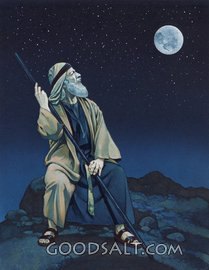 Gen. 12.1: Now Adonai said to Avram, “Get yourself out of your country, away from your kinsmen and away from your father’s house, and go to the land I will show you.” Accepted commentary: Even Abraham had to “go to the land I will show you.”
Gen. 12.1 continues with a promise: (2) “I will bless you, and make your name great; and you are to be a blessing.” The blessing follows the correct action. Abraham travels to the correct place! This principle is particularly important when walking in the Way. Position yourself for favor; actions count. Harvest and blessing must move with the right attitudes and motives. Blessing is received so that you may become the blessing.*
*Mt. 25.24, “You harvest where you didn’t plant and gather where you didn’t sow seed.” The servant sees the master as a hard man, but the master takes advantage of opportunity when he sees it, just as the servant should have done. This approach does not imply taking advantage of others. The Master takes action.
The right actions are necessary for daily living, but the principle of the blessing to follow is seldom mentioned. The first principle, right actions, we all understand as doctrinal or perhaps viewed by many as acting within societal or family standards; the second, concerning the blessing, is usually revelatory, but may refer to a physical blessing as well. Much like the movement of the spirit, we cannot always be sure where the blessing comes from or when it may arrive (Jn. 3.8, see Lazarus).
If they are honest, most people know the standards, but the blessing seems no more than a whisp of the wind, not seen coming and not seen going. That you may embody blessing is an unusual thought for most, yet it is a biblical standard that Jesus exemplified to all. Becoming a blessing to others refers to “you are to be a blessing.” Thus, it is good to sow a seed that you become a blessing, not only to yourself (within) but to others as well (without). When you begin to accept (receive) blessing, the soul is tempered, the heart is tempered, speech is tempered. Humility will sit upon thee, for where you go, blessing follows. You often see the shadow of this blessing in Jesus, not only in his acts but in his person. We see compassion and mercy; we see his actions with a blessing to follow. That you, in your person, should become the blessing demonstrates qualities that measure the Way.
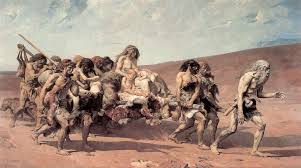 For those who admire the symbolic, perhaps Gen. 12.1 might read like this: “Get yourself out of your country [get yourself out of yourself], away from your kinsmen [away from your ideas relative to Self], and away from your father’s house [your spiritual childhood, where you started to grow up], and go to the land I will show you [get yourself placed].”
How much time do we spend fulfilling Abraham’s mission? Our shared mission is to attain the blessing, just as Abraham did.
Cain struggles; Abraham fulfills
‡
Good Sowing – First Fruits
Similar to Jesus explaining how the farmer sows, which is with expectation, James, in his manner, explains the faith of actions—take the basis of faith and renew your sowing, renew your good deeds, ask, seek, and knock. Such active measures of faith bridge to further fields ripe for sowing and ripe for harvest. Countering the value of sowing, it is a vanity that one should expect good outcomes while having done nothing (inferring sins of omission or lazy soul nature).*
Mt. 25.24-30, “You wicked, lazy servant!” The servant buried the money, where it could do no good.
Of its nature, faith extends itself into the circumstance and performs much like the forerunner of things to come. For this blossoming to occur, faith requires actions that demonstrate faith. A person may have some substance of faith as a reservoir, but without expression in circumstance, faith remains dead. James explains in 2.20 that faith without actions is dead—that which is activated has life or is working; that which is not activated remains potential, with the fruits of that second kind of faith delivered haphazardly.
Faith concerning deeds, more correctly interpreted as ‘actions,’ operates within a relationship with God. Opposed is faith not acted upon, and not acting cannot further a relationship with God. From 2.23, “Abraham had faith in God, and it was credited to his righteousness;” and from 2.25, “Rachel the prostitute also declared righteous because of actions when she welcomed the messengers and sent them out by another route;” and in 4.8, “Come close to God and He will come close to you,” these are values and lessons all men can practice.
Faith is emphasized in James’s written work, but not as we might initially think. No mention is made of Jesus as Savior or faith in Jesus, which will become the predominant faith theme of the later Christian church. James accredits Jesus as Messiah, but in his epistle, he references only Adonai. James speaks of perseverance (Jm. 1.3, also patience) and having a faith that treats all men equally (Jm. 2.5-8). James 1.18 infers faith as the “Word that can be relied upon,”* and faith is extended to make us as first fruits. In 2.1, James is clear, “My brothers, practice the faith of our Lord Yeshua, the glorious Messiah, without showing favoritism.”
*Jm. 1.18, “Having made his decision, he gave birth to us through a Word that can be relied upon, so that we should be a kind of first fruits of all that he created.”
KJ 1.18, “With His own will He begat us with the word of truth, that we should be a kind of first fruits for His creatures.
At first, many Christian readers are perplexed by James’s speaking, and that is because it comes from the root of Jewish tradition. In 2.20-24, James writes concerning Abraham, (22) “You see that his faith worked with his actions; by the actions, the faith was made complete.”
‡
How the Tongue Rattles
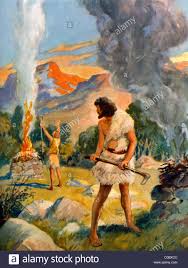
James 3.1, “Not many of you should become teachers, my brothers, since you know that we will be judged more severely. (2) We all stumble in many ways; if someone does not stumble in what he says, he is a mature man who can bridle his whole body.” James 3.5, “So too the tongue is a tiny part of the body, yet it boasts great things. See how a little fire sets a whole forest ablaze! (6) Yes, the tongue is a fire, a world of wickedness… (8) …it is an unstable and evil thing, full of death-dealing poison!”
The reference to “the tongue” is taken in the negative, such as gossip, which soon turns to slander. Constant murmuring leads to continual doubt and unhappiness. Misuse of speech can lead to problems, among them that the “death-dealing poison” begins to reside in you.
Cain stumbles; Cain boasts; he is filled with death-dealing poison.
 All people are made in the image of God, and therefore should be blessed, not cursed, v. 1.9-10, leading to v. 13, “Who among you is wise and understanding? Let him demonstrate it by his good way of life, by actions done in the humility that grows out of wisdom.”
Ambition and accomplishment are noteworthy, even necessary. Selfish ambition, however, denotes worldliness, and may even become demonic if allowed to go too far, v. 14-15; v. 17-18, “but the wisdom from above is, first of all, pure, then peaceful, kind, open to reason, full of mercy and good fruits, without partiality and without hypocrisy. And peacemakers who sow seed in peace raise a harvest of righteousness [within themselves, or blessing within and toward others].”
James continues into chapter four, still speaking about the tongue, when he writes v. 11, “Brothers, stop speaking against each other!” He admonishes that you will set yourself up as a judge when there is only one Judge. Throughout the epistle, the warnings of an ‘evil tongue’ are made clear. The solution lies in v. 3.10, “Out of the same mouth come blessing and cursing!” This is another way of saying to practice blessing, so there is no kindling for the next fire of anger. Wisdom and the wise use of the tongue are emphasized throughout James’ epistle. Wisdom in all endeavors becomes the completion of the Way.
Ask to be blessed; ask to be anointed. Be willing to speak the Word in matters of importance or immediacy and offer sincere prayer. Throughout his epistle, James directs us to examine character attributes, then guides us in taking proper actions. Sowing seed in peace, being open to reason, and being full of mercy is Christ’s character.
‡
Quarrels and Prayer
Little has been mentioned on this website concerning prayer. The reason is that prayer is a personal experience; each person prays in their own way, and confession is a personal and private matter. However, James has a few things to say about worship amid strong disagreements.
Chapter Four begins: “What is causing all the quarrels and fights among you? Isn’t it your desires battling inside you?”
This letter is for the burgeoning church, but it is directed to each person, as James intimates. “Quarrels and fights among you” could be as easily written as “Quarrels and fights within you,” for that is what has occurred. The following sentence, “Isn’t it your desire battling inside you,” confirms how the various congregants had lost their way. It is just as accurate that such quarrels and battling at times rage within us and, in doing so, reflect the nature of the actual pathway someone has chosen or is engaged in. These pathways can lead to wrath, confusion, and discarding what could be good for a shamble of understanding which can be misguided. Many earthly teachings will lead a soul in this direction.
(v.2) “You desire things and you don’t have them.” The Desire to acquire out of season is one primary complaint most commentators make concerning Eve. Similarly, Adam desired to release his responsibility so that he, too, could indulge in the same pleasure. She blamed the Satan-serpent; Adam blamed her, but also indirectly blamed God—“the woman you gave me.” Adam seems fine with his justification, and Eve is just as casual, as if that is all that is necessary, much as most of us do. The church faces a similar issue. James addresses the congregants’ justifications; each person wishes to establish the proper church through their reasoning, but does not inspect themselves, nor are they moving through the spirit, nor apparently in love.
(v.2) “The reason you don’t have is that you do not pray.” Arguing had taken the place of prayer. James advises that the congregation should confess this ill-tempered pathway and resolve differences, but so too is the exact situation portrayed in each person’s life. It could be asked of each of us, ‘Just what kind of a church are you running inside yourself, and why is quarreling and unhappiness continuing?’ Prayer moves the spirit forward to its proper position so that the spirit can act within you, seen and unseen, known or unknown, and prepare your ground for good seed.
 The kingdom within is much like a church. You live in that kingdom, and you go to that church. The constant arguing and justifications perhaps expose the fundamental error of not attending to the kingdom, and not one wit of looking at Self and then to seek, ask, or knock. The element of prayer is powerful, for no matter what you know or how much the spirit has witnessed for you, seeing and knowledge are not the same as direct communion with God.
(v.3) “Or you pray and don’t receive, because you pray with the wrong motive, that of wanting to indulge your own desires.”* The Way directs you to deal with yourself first, then look at the issue. Much like speaking from the spirit (speaking the Word), a person should employ prayer for essential matters, communion, His presence, and oneness. Confession works wonders. Forming a church cannot be done according to one’s own desires, but rather according to God’s Desire. So, it is within each individual.
*(CJSB footnotes) “You pray with the wrong motive. Not all prayers are pleasing to Adonai, especially from selfish motives. All t’fillah (prayer) must be in line with God’s will and scripture (I John 5.14-15).”
(v. 17) “So then, anyone who knows the right thing to do and fails to do it is committing a sin.” These right actions are typically regarded as addressing more critical matters, or may be actions that bolster a faith initiative. This scripture provides a fundamental principle of the Way—continue to do the right thing. James is writing to a whole congregation, one that is engaged in anger, recrimination, perhaps fundamental differences in understanding, and spiritual philosophy—we see this struggle in our own lives and with those whom we congregate.
We cannot make one person a congregation, nor can we make a congregation one person, but James’ epistle lays down much of what Jesus would have us do. Gained by measure, each person’s enlightened journey will be tested; life itself dictates that this is so. In James, we see churches being tested.
Chapter Five reveals an interesting statement in verse twelve. “Above all, brothers, stop swearing oaths—not, “By Heaven,” not “By Earth,” and not be any other formula; rather, let your yes be “Yes” be simply “Yes” and your “No” simply “No,” so that you will not fall under condemnation.” This passage indicates that James had Essene training. Commoners, including Pharisees and Sadducee priests, when swearing to tell the truth, would swear by Adonai, or, popular at the time, by swearing on their mother’s grave.
Not so the Essene; the Essenes were expected to always tell the truth as their order required. According to the Essenes, any other oath rubbed shoulders with blasphemy, for you are convening your oath with God—you have associated God with your own words and workings. Much as YHWH was not written or spoken for the same reasons (Adonai was used), including God in your ‘fleshly’ business by swearing oaths becomes a convenience of familiarity, which is inappropriate.
If James is issuing this plea for ceasing all oaths, and Jesus remonstrated on the same topic (Mt. 5.37), we have an acute point lending the thought that both Jesus and James were Essene, as many scholars believe. But since Jesus was called the Nazarene, both would have been a part of Nazarene Essene theology and practice. The priesthood strictly adhered to the Essene knowledge base and its interpretation of wisdom.
The improper mixing of spirit and flesh was already widely known, with the tales of the Watchers most prominent. Jesus comments on giving Caesar what is his and giving God what is His. Forgive others and make things right before you pray. If you judge and condemn but cannot forgive, you live with judgment as your parcel, and by possessing judgment, you will be judged. For the teaching of the Way, Jesus speaks of not my will but thine, again separating flesh and spirit. This awareness of values and where value is placed imparts clarity and a certain spiritual precision.
Verses 19 and 20 close the Epistle of James: “My brothers, if one of you wanders from the truth, and someone causes him to return, you should know that whoever turns a sinner from his wandering path will save him from death and cover many sins.”

God Bless!
Thanks on your marvelous posting! I really enjoyed reading it, you can be a great author.I will always bookmark your blog and definitely will come back later in life. I want to encourage you to continue your great writing, have a nice afternoon!
This website is really a stroll-by way of for the entire info you wanted about this and didn’t know who to ask. Glimpse right here, and you’ll undoubtedly uncover it.
Sweet internet site, super design and style, real clean and apply genial.
This is really attention-grabbing, You’re an excessively skilled blogger. I have joined your rss feed and sit up for in the hunt for more of your great post. Additionally, I’ve shared your site in my social networks!
Great line up. We will be linking to this great article on our site. Keep up the good writing.
Hello there, just became alert to your blog through Google, and found that it’s really informative.
I am going to watch out for brussels. I will be grateful if you continue this in future.
Numerous people will be benefited from your writing.
Cheers!
Hello. magnificent job. I did not anticipate this. This is a great story. Thanks!
I’d have to test with you here. Which isn’t something I usually do! I take pleasure in studying a publish that can make people think. Additionally, thanks for permitting me to remark!
A lot of thanks for your own hard work on this site. Ellie delights in participating in internet research and it’s easy to understand why. We hear all about the powerful means you present helpful information via this web site and even strongly encourage response from other individuals on the situation while our own princess is now being taught a great deal. Have fun with the remaining portion of the year. You’re conducting a remarkable job.